Wow do I like when teachers take control and set up their own collaborative teams beyond their own school borders to help each others' students. Above is a great example of this where three great flipping teachers came together to create a video on a fun way to remember a number of US history facts. Give it a try and assume, as I am, that this is the first of many in a series.
Wednesday, January 29, 2014
History Tips From Three Educators
Wow do I like when teachers take control and set up their own collaborative teams beyond their own school borders to help each others' students. Above is a great example of this where three great flipping teachers came together to create a video on a fun way to remember a number of US history facts. Give it a try and assume, as I am, that this is the first of many in a series.

Sunday, January 26, 2014
Video Documentary Assignment
One of the people I follow on Twitter is Jen Carey. She also has an Internet page called "Indiana Jen" which goes through a number of her assignments. What I like about this post is that it goes through into detail how students can create their projects. It even includes a way for students to know if a webpage they are using is a good one as well as the fact that kids need to write out their script before recording their screencast.
Above is an example of one of her students' work.
Saturday, January 25, 2014
Instagrok Mindmaps

I have been using Instragrok for the past two years and am happy that it has really taken a big step upwards. Instragrok sets up the connections between different items. Above is a small example for the American Civil War. What is really cool about Instragrok is that in addition to setting up a mind map, it also brings up websites, videos, images, concepts and you can even add notes. You can also get a unique url that you could give your students, or they you.
Friday, January 24, 2014
Parady Song of the American Revolution
My son Grant watched this at school. It really does cover many of the many points leading up to the American Revolution and to a tune all your students will recognize.
Entire US History Course for Free
The American Home Front (WWII) from Tom Richey
From time to time I like to look at who is following me on Twitter to see if I want to find them as well. Well recently Tom Richey started following me and it turns out he has a very rich website which has a complete US History for both AP and honors that includes readings, worksheets and PowerPoints and gives you the ability to copy whatever you want.
From time to time I like to look at who is following me on Twitter to see if I want to find them as well. Well recently Tom Richey started following me and it turns out he has a very rich website which has a complete US History for both AP and honors that includes readings, worksheets and PowerPoints and gives you the ability to copy whatever you want.
Tuesday, January 21, 2014
Mistakes that Changed History
My post yesterday was inspired by the video above and which talks about mistakes that changed history. I particularly liked the one on Gavrilo Princip as I had incorrectly thought he had failed in the AM to kill Franz Ferdinand when, in fact, it was another co-conspirator. More to the point while it features Keith Hughes, it also brings in two newer people collectively known as That Was History that has both US and world history videos.
Monday, January 20, 2014
Another Side of MLK, Jr.
One of the problems with our US textbooks is that there are too many facts and not enough stories which is why I enjoy using primary documents to teach US history. But the video above is why it is nice to teach the last one hundred years because you can get some more personal narratives such as the clip above from Martin Luther King, Jr.'s driver as he moves around and shows you places that MLK drove that didn't make the history books.
Misunderstanding History
I sense an assignment coming on or even an end of the year project if we can get beyond all of our snow days. As I like to tell my students we study history in part of understand different cultures and to be able to better relate to people around the US and the world. So why not have your students look at one misunderstanding and try to be a sleuth and figure out why we have accepted this falsehood as fact today.
Consider the fact that Paul Revere did not say "The British are coming." To say such would be akin to saying "The Americans" were coming since we were all British (he said the "Regulars" were coming). While we are at it why do we best remember Revere when he was the only one the Regulars captured that night while Dawes and Prescott did a better job of warning residents. But neither of the other two were memorialized in a Longfellow poem nor had physical items (pewter, pictures) to be stored by history. While we are it, what about Revere's own work in calling the Boston Massacre a massacre and in copying someone else's work and claiming it to be his own!
What about the belief that Columbus proved the world was round which was patently false and had long been accepted otherwise. The why we see it that way is a better question and most believe that Washington Irving was the conveyer of that falsehood.
Of course the tallest of tales is the one that says that Napoleon was a bully because he was short when the reality was he was average height for his time.
Here are a bunch of misperceptions that you can start with showing your students.
So imagine the assignment. 1) student has to find a misperception 2) explain how it got to be a misunderstanding which in of itself is good analysis 3) how, if it did change history. While you are at it, watch the video above for some inspiration.
The Virtues of Tammany Hall!

Sunday, January 19, 2014
Flipped Classroom on CBS News
I love that CBS refers to the flipped classroom as a new way to teach, but at least they interview two of the pioneers - even if they don't go back to the true originators (for that you have to read my book!). If you are flipping, think about it and watch the video to be convinced.
Friday, January 17, 2014
Ben Franklin Timeline

PBS Learning has a ton of wonderful items on its amazing site for you to use in your class.
Thursday, January 16, 2014
Black Codes

There is also a video on the origins of black codes.
Here is a series of the actual code from Mississippi.
Friday is the Last Day to Sign Up for my Tech Integration Course
Sorry to my regular blog readers outside of Fairfax County, but I love teaching my Academy Course and just wanted to remind people that tomorrow (Friday) is the last day to sign up. So in case you are considering it (or haven't considered it yet):
 I will be teaching the sixth version of my technology integration course with Fairfax County Public Schools this spring. We will learn about such items as webquests, pacing your students individually using technology, flipping the classroom, using electronic textbooks, collaborating online, how to use Google Drive and lots more in a ten week course. You can get more details here on page 42. To sign up go to MyPLT (if you need help go to page 72) and put either the title or just a few words from the title or even e-mail me and I can add you to the class. The deadline for signing up is January 17th.
The class will be on Thursdays from 4:30 to 7ish at Woodson. It is free to FCPS employees, but if you live in the areas and are not in FCPS you can take it, but you have to pay for it (page 9). If you have questions, please e-mail me at ken.halla@fcps.edu.

The class will be on Thursdays from 4:30 to 7ish at Woodson. It is free to FCPS employees, but if you live in the areas and are not in FCPS you can take it, but you have to pay for it (page 9). If you have questions, please e-mail me at ken.halla@fcps.edu.
Wednesday, January 15, 2014
SkyDrive Tutorial
So it would be fair to say that I prefer Google Drive over Microsoft's SkyDrive. SkyDrive is the cloud based way to use Microsoft. It is not as robust as Google Drive in that it does not have any apps you can add, nor can you run scripts and has less free space, but it has been growing in the last two years. To start you have documents, excel, PowerPoint or one note to create and upload files from Microsoft Office.
Above is a fairly nice video on how to use SkyDrive.
Above is a fairly nice video on how to use SkyDrive.
Digital Learning Day Post
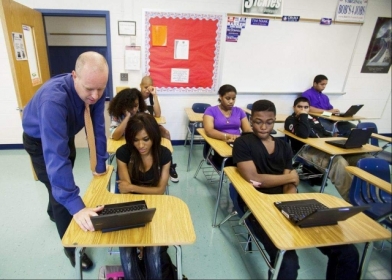
Last year in my Digital Learning Day post for the Alliance for Excellent Education I said that "One day all of our students will have interactive lessons where the teacher will walk around the room connecting information, helping pupils do their work and making sure that the necessary learning is being done correctly and where appropriate, collaboratively. Classes will be self paced and conclude with interactive assessments that measure students' ability to find and use resources to answer probing questions."
Interesting what a year brings. This spring I have a book coming out from Corwin Books talking about just what is printed above (something I had no idea about when I wrote the post). I am also co-teaching, for the first time in my career, and doing it with an ESOL/World History I class. Fully half of the kids have been in the US fewer than two years and all but a few of the students are either immigrants or ones who do not speak English at home.
To that end we have flipped every single lecture (nothing profound, but all less then ten minutes which you can see here) and have our students working at different paces. One parent told me her daughter was looking at the videos and webpages and wondered why she hadn't been reading more of the book. I told her we were using multiple modalities and the e-book was just one of the resources. But that child has only been speaking English a few years and finds it helpful to over over each video several times.
We also proved to the kids a valuable lesson telling them on the most recent unit that no one would be allowed to take the test until the study guide was completely done. Between our two classes twelve kids tested us and we pulled each one in the hall individually and called home asking that their child stay after school to take the test and then had them sit down to work on the study guide. Guess what? The ESOL kids tied the test scores of the mainstream ones and all our students were EIGHTG percentage points over the school average for the test!
Why did that happen? Well rather than waste student time on lecture based teaching we spent the entire unit (and by now my cooperating teacher and I have adjusted quite well to each other) walking around and working one on one with each student. Furthermore we probably call up 1/3rd of the students on a given day to look at grades and even to have student-parent-teacher conferences in the hall to work out issues. We also have added in several formative quizzes each uint and the kids can take them as many times as they want to raise their grades.
Subscribe to:
Posts (Atom)